Printable event safety resource
Beaufort Wind Scale & Inflatable Wind Safety Guide
Wind can change quickly at a community park, resident festival, or clubhouse activity area. Use our Wind at a Glance chart, based on Beaufort wind-scale observations, to recognize visual clues such as moving leaves, extended flags, and swaying branches.
Stop inflatable use at 15 mph or higher, including gusts—or sooner if the inflatable’s instructions or our team specify a lower limit. Have everyone exit, then follow the safe shutdown instructions provided with your rental. Do not wait for the inflatable to move.
- Monitor the actual setup area. Use an appropriate wind meter (anemometer) and watch for gusts; a phone forecast is not an onsite measurement.
- Act before conditions become unsafe. Stop admission, help all users exit, and follow the supplied shutdown and deflation instructions. Keep anchors in place.
- Ask before restarting. Keep the inflatable closed until conditions meet its operating instructions and our team’s guidance.
The chart’s ranges are approximate. Visual clues cannot confirm that wind is below 15 mph or authorize operation. A properly anchored inflatable still has wind restrictions.
Open the PDF and use your browser’s download or print control. Share a printed copy with your event supervisor, community volunteers, and activity attendants.
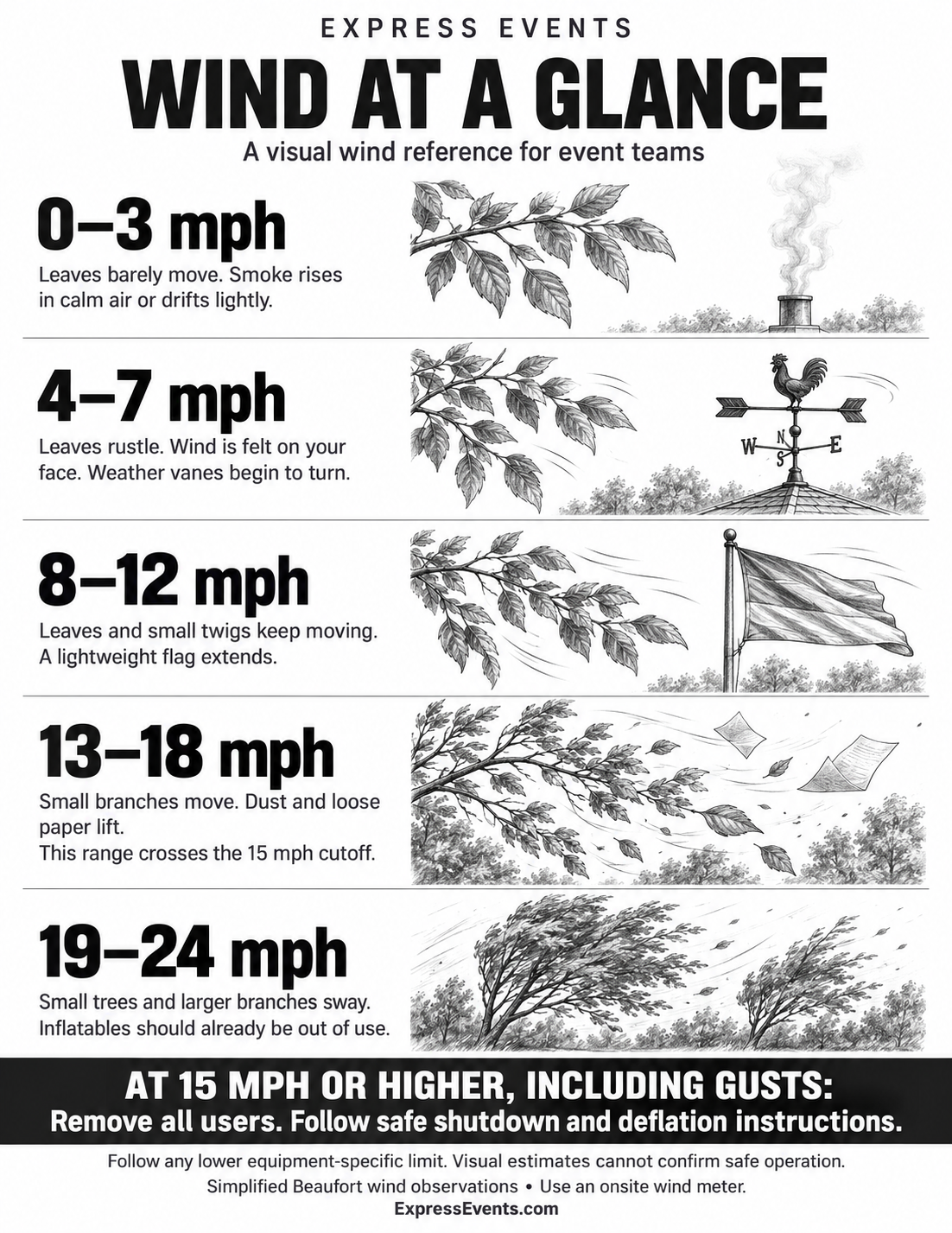
Wind chart text reference
- 0–3 mph
- Leaves show little movement; smoke rises in calm air and drifts in a light breeze.
- 4–7 mph
- Leaves rustle, wind is felt on your face, and weather vanes begin to turn.
- 8–12 mph
- Leaves and small twigs keep moving; a lightweight flag extends.
- 13–18 mph
- Small branches move; dust and loose paper lift. This range crosses the 15 mph cutoff—do not use it to judge that operation is safe.
- 19–24 mph
- Small trees and large branches begin to sway. Inflatables should already be out of use and deflated following the supplied instructions.
Further reading: National Weather Service Beaufort Wind Scale and CPSC inflatable amusement safety guidance.
Inflatable Wind Safety Questions
What wind speed is too high for an inflatable?
Stop use at 15 mph or higher, including gusts, or at any lower limit specified for your inflatable or by our team. Do not treat a higher wind limit quoted for another inflatable as permission to keep this rental operating. Have all users exit before following the supplied shutdown and deflation instructions. Stop sooner if conditions appear unsafe, anchoring is affected, or the inflatable moves unexpectedly.
Do short wind gusts count even when the average wind is lower?
Yes. Gusts matter even when the sustained wind or phone forecast looks acceptable. Monitor the actual event area, including changes near buildings, open fields, and storm activity. Do not average away an unsafe gust or wait for a weather alert before stopping use.
What is the Beaufort Wind Scale, and can it tell us an inflatable is safe?
The Beaufort Wind Scale relates wind strength to observable effects. Our Wind at a Glance chart provides a simplified land-based reference using leaves, twigs, flags, dust, and trees.
It is an approximate reference, not a measurement or a go/no-go test. It cannot confirm that wind is below 15 mph. Use an appropriate onsite wind meter and follow the specific inflatable’s operating instructions and our team’s guidance.
Who should monitor wind at a HOA or community event?
Assign a responsible adult to monitor conditions and communicate with the attendants supervising each inflatable. Confirm the inflatable’s wind limits, wind-meter use, and shutdown procedure with our team at setup. Delivery and setup alone do not provide ongoing event supervision.
A weather app is useful for planning, but does not measure wind and gusts at your setup location. Monitoring must continue while equipment is operating.
What should we do if wind picks up during the event?
Stop admission and have everyone exit immediately. Follow the safe shutdown and deflation procedure provided with your rental. Keep anchors and tie-downs in place; do not move the inflatable or add improvised ballast. Keep guests away and contact our team.
Do not touch wet electrical connections, enter standing water, or attempt a risky shutdown. Follow our rain and electrical safety instructions if water is involved. Do not try to hold down an inflatable that is lifting.
Can extra stakes or sandbags make an inflatable safe in high winds?
No. Proper anchoring does not eliminate wind restrictions. Leave the installed anchors and tie-downs in place and do not modify the setup or attach it to vehicles, fences, or other objects. If the wind limit is reached or conditions are unsafe, stop use rather than trying to compensate with more ballast.
When can we reopen an inflatable after a wind shutdown?
Do not restart simply because one gust has passed. Contact our team and follow the instructions for your rental. Conditions, anchoring, equipment, and electrical safety must be suitable before any return to operation. Keep users out until the unit is properly reinflated and the required checks are complete.
Where can we download the printable wind chart?
Open the Wind at a Glance PDF and use your browser’s download or print control. Share the reference with your event attendants and volunteers alongside the rental’s operating instructions.